WebAR for Ecommerce: How Browser-Based AR Turns Product Pages Into Try-Before-You-Buy Experiences.
Overview
WebAR · Ecommerce · Product Visualization · 2026
WebAR for Ecommerce: How Browser-Based AR Turns Product Pages Into Try-Before-You-Buy Experiences
By Elipse Studio · August 2026 · 11-minute read

⚡ TL;DR — Quick Answer
WebAR for ecommerce lets shoppers point their smartphone camera at their actual room and see a 3D product — a sofa, a lamp, a car wheel, a sneaker — placed at accurate scale in their real space, all through a standard mobile browser with zero app download required. This try-before-you-buy experience directly addresses the primary reason ecommerce purchases go wrong: buyers cannot accurately judge scale, color accuracy, or spatial fit from flat photography. Elipse Studio builds custom WebAR product experiences for ecommerce brands worldwide — embedded directly in Shopify, WooCommerce, and custom product pages — using 8th Wall and the WebXR Device API for iOS Safari and Android Chrome compatibility since 2014.
Adding WebAR to your product pages?
Elipse Studio builds WebAR experiences that embed directly into your existing ecommerce platform — no app, no friction, no rebuild.
Every ecommerce return tells the same story. A buyer looked at a product photograph, made a reasonable judgment about how it would look in their space, bought it, received it, and discovered the judgment was wrong. The sofa was larger than the room felt it could accommodate. The rug color read differently under natural light than under studio lighting. The lamp was 30% shorter than the bedroom side table implied it should be. The photograph was accurate. The buyer's spatial imagination was not. And the return was inevitable.
This is the imagination gap — the commercial problem that WebAR for ecommerce is built to close. When a buyer can point their phone camera at their actual room and see the product placed there at accurate scale, under real lighting, before they buy, the imagination gap disappears. The return goes with it. And conversion rises because purchase confidence is no longer a function of how good the buyer is at mental spatial reasoning. It becomes a function of how good the product actually is.
Elipse Studio has been building WebAR product experiences for ecommerce brands since the technology became commercially viable — and 2026 is the year when browser-based AR has cleared every adoption barrier that previously kept it niche. This guide covers what WebAR is, how it works technically, what it delivers commercially, and which product categories benefit most from embedding it directly in product pages.
What Is WebAR and How Is It Different From App-Based AR?
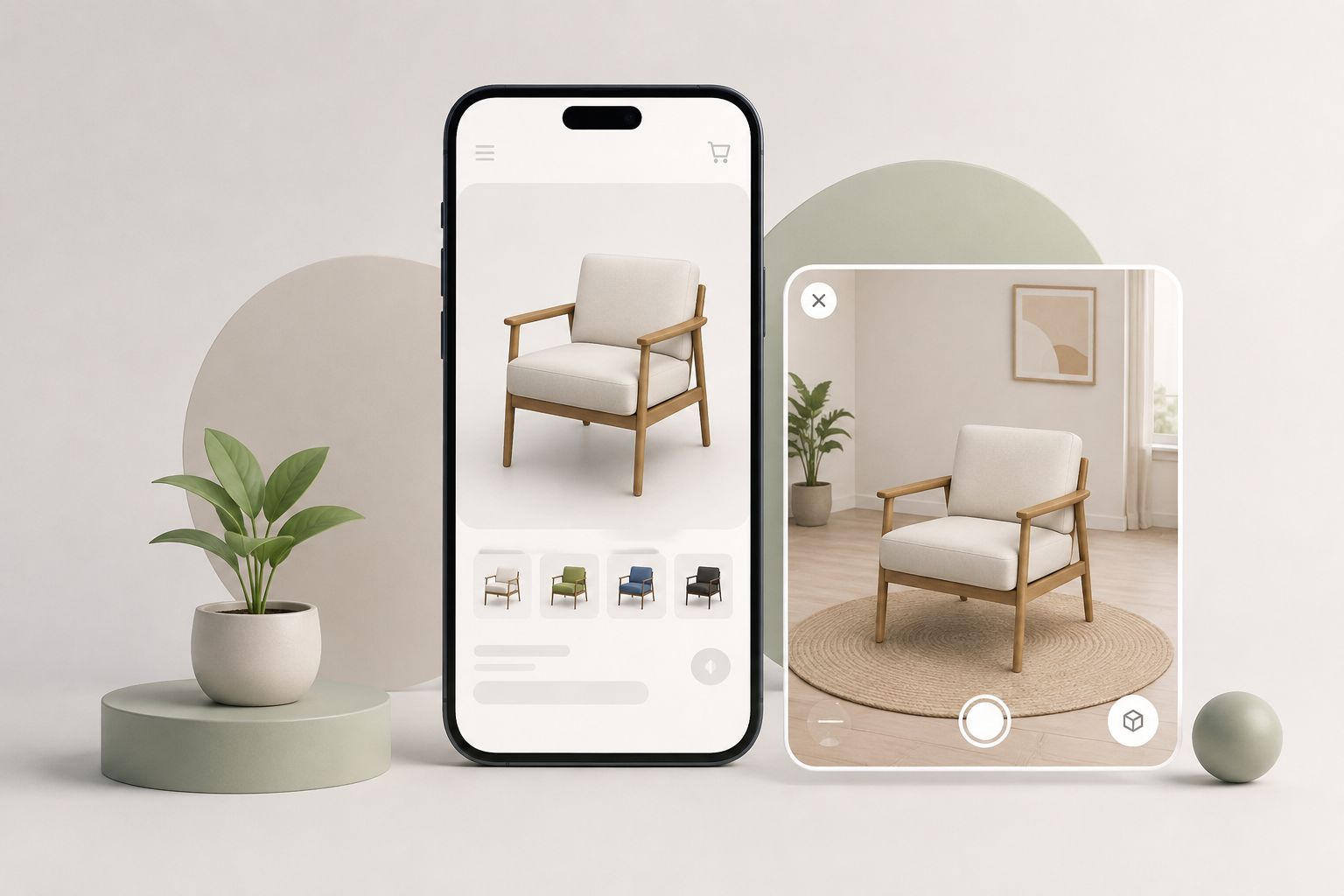
WebAR is augmented reality that runs directly in a mobile web browser — iOS Safari, Android Chrome — without requiring the user to download any app. A shopper taps a "View in Your Room" button on a product page, their browser requests camera access, and within seconds the product appears in their real space on their phone screen, anchored to the floor or surface, at accurate scale, rendering correctly under the ambient lighting of the room they are actually in.
The distinction from app-based AR matters commercially more than it does technically. App-based AR — the kind that requires a dedicated download — consistently suffers from a friction problem. Studies consistently show that requiring an app download at the point of purchase intent drops engagement by 70% or more. Shoppers who were ready to buy are asked to pause, navigate to an app store, install software, return to the browser session they were in, and then try the feature. Most do not. The feature exists in the app store review count but creates almost no commercial impact at the product page level.
WebAR removes this entirely. The experience lives on the product page. It requires one tap and a camera permission grant that takes three seconds. The buyer never leaves the purchase context. The AR session ends and the Add to Cart button is right there. This frictionless delivery is why WebAR adoption among serious ecommerce brands has accelerated sharply — the technology has caught up with the commercial requirement.
94%
Conversion rate lift for Shopify merchants who added 3D and AR product views
35%
Return rate reduction reported by furniture brands with AR room placement
5×
Higher engagement for WebAR vs app-based AR — zero download friction
71%
Of consumers say they would shop more often if AR was available
How WebAR Works Technically — What Elipse Studio Builds
Understanding the technical components of WebAR helps ecommerce brands evaluate what a quality implementation actually requires — and why the quality of the 3D asset is as commercially important as the technology delivering it.

The AR Engine — 8th Wall and WebXR Device API
Elipse Studio builds WebAR experiences on two primary platforms: 8th Wall for maximum cross-device compatibility and feature depth, and the native WebXR Device API for environments where licensing overhead should be minimized. 8th Wall provides world tracking, image tracking, and face tracking across iOS Safari and Android Chrome — covering the vast majority of mobile browser traffic. Apple's ARKit Quick Look (USDZ format) and Android's Scene Viewer (GLB/glTF format) provide native OS-level AR for the specific "View in AR" button use case on product detail pages without requiring a JavaScript AR engine at all.
The 3D Asset — Where Commercial Value Is Actually Created
The AR technology delivers the experience. The 3D asset determines whether the experience is commercially useful. A product placed in a buyer's room via WebAR using a low-quality 3D model — inaccurate dimensions, flat textures, no surface detail — creates skepticism rather than purchase confidence. The buyer sees something that does not look like the product they are considering buying, and the friction it was supposed to remove is replaced by different friction: doubt about whether the rendering is accurate.
Elipse Studio produces every WebAR 3D asset from the product's actual specifications — CAD files, physical sample reference, manufacturer dimension sheets. PBR materials (physically based rendering) replicate how the product's surfaces respond to different lighting conditions: the same sofa in a buyer's dark bedroom renders differently than in a bright living room, because the material is modeled to respond to light physically accurately rather than baked to look good under studio lighting only.
Surface Detection and Accurate Scale Placement
The commercial value of WebAR room placement depends on two things being true: the product must appear at accurate scale, and it must anchor correctly to the surface it is placed on — floor for furniture, tabletop for smaller items, wall for artwork and shelving. World tracking algorithms in 8th Wall and WebXR analyze the camera feed in real time to detect planes, estimate scale from the environment, and anchor 3D objects with the stability that makes the placement believable. Elipse Studio's WebAR implementations include scale calibration, surface snapping, and rotation controls that let buyers reposition and reorient products naturally with touch gestures.
Ecommerce Platform Integration
A WebAR experience that is not integrated into the purchase flow creates curiosity but not conversion. Elipse Studio embeds WebAR directly into existing product pages — Shopify and Shopify Plus product detail pages, WooCommerce product templates, Magento and custom ecommerce frontends — as a feature of the product page itself rather than a separate tool the buyer has to find. The AR session launches in context, ends in context, and the buyer's next action is the Add to Cart button, not a navigation step to find their way back. Explore our full AR development services for the complete technical scope.
WebAR Ecommerce Use Cases — Where It Delivers Strongest ROI
WebAR delivers strongest commercial returns in product categories where the imagination gap between flat product photography and real-world experience is widest — and where that gap is directly responsible for purchase hesitation, abandoned carts, and post-purchase returns.
Furniture and Home Décor
The original and strongest WebAR use case. Furniture buyers need to know three things photography cannot tell them: how large the piece actually is relative to their room, how the color reads under their specific lighting, and whether the style works alongside their existing furniture. WebAR room placement answers all three simultaneously, in the actual space where the purchase decision is being made. Brands in this category consistently report 25–40% return rate reductions and significant conversion rate lifts from adding WebAR to product pages. Explore Elipse Studio's virtual showroom and 3D visualization services for the complete furniture ecommerce scope.
Consumer Electronics and Appliances
Televisions, speakers, kitchen appliances, and smart home devices all suffer from a scale problem in ecommerce. A 65-inch television photographed on a white background conveys almost nothing about how it will look on a specific wall in a specific room. A refrigerator shown in a lifestyle kitchen image may look perfectly proportioned — but is it proportioned for the buyer's kitchen? WebAR places the television on the buyer's actual wall, the refrigerator in the buyer's actual kitchen alcove. The scale question is answered before the purchase, not discovered at delivery.
Automotive and Powersports
Buyers configuring vehicles online face the same spatial imagination challenge as furniture buyers. The paint color that looked right on a studio render may read completely differently in a driveway under overcast skies. Elipse Studio builds WebAR vehicle placement as an extension of the automotive configurator — after a buyer completes their configuration, they can place their configured vehicle in their actual driveway, in their actual lighting conditions, at their configured paint color and wheel selection. This closes the commitment gap that even a high-quality studio render cannot.
Fashion and Footwear
Face-based and body-based WebAR enables virtual try-on for eyewear, watches, jewellery, and footwear directly in the browser. A buyer can see how a specific pair of glasses sits on their face, how a watch reads on their wrist, or how a sneaker colorway looks on their foot — all without an app, all in the same browser session where they found the product. Fashion brands using WebAR try-on report measurable lift in conversion rate and reduction in size and style-based returns.
Architecture and Real Estate
Property developers and interior design brands use WebAR to let buyers visualize material selections — flooring, tiling, wall cladding — in their actual spaces. Rather than looking at a sample tile on a website and imagining how it will look across the floor of a kitchen, buyers view the material rendered across their actual floor, at real scale, under their actual lighting conditions. This is the spatial decision support that material selection has always needed and photography has never been able to provide.
See how WebAR performs on your product category
Elipse Studio scopes every WebAR project from your product range, platform, and commercial conversion objectives.
Discuss Your WebAR Project →WebAR vs App-Based AR — The Commercial Case for Going Frictionless
The technical question of which AR delivery method to choose is, at its core, a commercial question about where you are willing to lose buyers in the funnel.
How Elipse Studio Delivers WebAR for Ecommerce
Elipse Studio approaches every WebAR ecommerce project from the commercial outcome first: what specific buyer hesitation are we removing, what return rate are we targeting, what conversion metric are we optimizing for? The 3D asset production, AR engine selection, and platform integration follow from that commercial clarity — not from what the technology makes easy to build.
Every WebAR asset Elipse Studio produces begins with the product's actual specifications — manufacturer dimensions, material samples, finish references. PBR materials are built to replicate how each surface responds to the variable lighting conditions buyers will actually encounter in their homes, not how they look under the controlled lighting of a studio shoot. This production standard is what makes the AR experience commercially useful rather than visually impressive but functionally misleading.
Integration is built for the full buyer journey. The WebAR experience launches from the product page, adds configurator connectivity where the product has selectable options — so buyers see their configured version in their room, not a default — and returns the buyer to the purchase flow with minimal friction. Analytics track AR session depth, product interactions, and downstream conversion for every implementation, giving brands the measurement data to optimize and expand the feature.
Industries and Platforms Elipse Studio Supports for WebAR
Elipse Studio builds WebAR product experiences across ecommerce platforms and industry categories. Shopify and Shopify Plus are the most common commerce platform — WebAR integrates natively through the product metafields and Shopify's built-in model-viewer support for USDZ and GLB assets. WooCommerce builds use custom product page templates with WebXR JavaScript integration. Magento, BigCommerce, and custom frontends use an iframe or JavaScript snippet embed that keeps the buyer on the product page throughout the AR session.
Industry coverage spans furniture and home décor (room placement), consumer electronics (scale preview), automotive and powersports (vehicle placement and configurator extension), fashion and footwear (face-based and foot-based try-on), beauty and cosmetics (face AR shade matching), architecture and real estate (material visualization), and B2B product demonstration (complex equipment shown in the buyer's actual facility). If your product creates a spatial imagination challenge for buyers — a question that photography cannot answer about scale, color accuracy, or context fit — WebAR is the technology designed to answer it. View Elipse Studio's AR development practice and portfolio for deployed examples across these categories.
Frequently Asked Questions
What is WebAR and how does it work on a product page?
WebAR is augmented reality that runs directly in a mobile browser — no app download required. A buyer taps a "View in Your Room" or "Try On" button on a product page, the browser requests camera access, and within seconds the 3D product appears placed in their real space at accurate scale. It works on iOS Safari (USDZ / WebXR) and Android Chrome (GLB / WebXR). Elipse Studio embeds WebAR directly into Shopify, WooCommerce, and custom product pages as a native page feature.
Does WebAR work on iPhones and Android phones?
Yes. WebAR works on iOS Safari using Apple's ARKit Quick Look (USDZ 3D format) and the WebXR Device API for custom implementations. Android Chrome uses Scene Viewer (GLB/glTF format) and the WebXR Device API. Elipse Studio produces both USDZ and GLB asset versions for every WebAR implementation, ensuring consistent experience across both platforms from a single "View in AR" button on the product page.
Which ecommerce platforms does Elipse Studio integrate WebAR into?
Elipse Studio builds WebAR integration for Shopify and Shopify Plus (via product metafields and native model-viewer), WooCommerce (custom product template), Magento and Adobe Commerce, BigCommerce, and custom Next.js or headless ecommerce frontends. The integration keeps the buyer on the product page throughout the AR session — no redirect, no session interruption, no navigation back to find the Add to Cart button.
How important is 3D asset quality for WebAR ecommerce?
3D asset quality is the primary determinant of whether a WebAR experience creates purchase confidence or undermines it. A product rendered with inaccurate dimensions, flat textures, or incorrect surface materials creates doubt rather than certainty — the opposite of the commercial goal. Elipse Studio produces every WebAR asset from actual product specifications with PBR materials matched to physical sample reference, ensuring the digital representation is a commercially accurate preview of the physical product.
What ROI can ecommerce brands expect from WebAR?
Ecommerce brands adding WebAR to product pages report conversion rate lifts of 40–94% for products where buyers used the AR feature, return rate reductions of 25–35% for spatial products like furniture and large appliances, and higher average order values from increased purchase confidence. The ROI compounds in categories where returns are costly — fashion, furniture, consumer electronics — because every percentage point of return rate reduction has significant impact on margin.
How long does it take to add WebAR to an existing ecommerce store?
Adding WebAR to an existing Shopify or WooCommerce store with 3D assets already available typically takes 2–4 weeks. Projects requiring 3D asset production from scratch — modeled from physical products or CAD files — span 6–12 weeks depending on the number of SKUs and variant count. Elipse Studio scopes every WebAR project based on asset production requirements, platform integration complexity, and the number of products being enabled.
The Bottom Line — WebAR Is the Imagination Gap Closed
The imagination gap in ecommerce is not a new problem. Buyers have always struggled to make accurate spatial judgments from flat photography, and brands have always absorbed the cost of that failure in returns, negative reviews, and lost repeat purchase. What changed in 2026 is that closing the gap is no longer technically difficult or commercially prohibitive — WebAR runs in the browser every buyer already has, on the device they are already holding, integrated into the product page they are already on.
The remaining variable is execution quality. A WebAR experience built on inaccurate 3D assets or integrated as an interruption to the purchase flow does not close the imagination gap — it adds a new one. The brands seeing 94% conversion lifts and 35% return rate reductions from WebAR are the ones who built it right: accurate 3D, accurate materials, embedded in the product page, connected to the configurator where one exists, and measured from day one. Elipse Studio builds it that way — for ecommerce brands worldwide, since 2014.
Elipse Studio · WebAR for Ecommerce
Ready to Add Try-Before-You-Buy to Your Product Pages?
Tell Elipse Studio about your products, your platform, and the return rate or conversion challenge you need to solve. Our team responds within one business day with a scoped approach for your WebAR project.
Related Resources from Elipse Studio
Brands exploring WebAR can also read about AR for brands across commerce, marketing, and field support, explore how 3D product configurators increase ecommerce conversion, see our AR development services, and contact Elipse Studio to scope your WebAR ecommerce project.
Latest Work
Contact Us
Let’s build something remarkable.
Share your project details and we’ll craft an experience your audience will remember.
Or reach out directly for a quicker response