Virtual Product Configurator for Retail & Ecommerce Brands 2026.
Overview
Virtual Product Configurator · Retail · Ecommerce · 2026
Virtual Product Configurator for Retail & Ecommerce Brands: ROI, Use Cases & How It Works
By Elipse Studio · August 2026 · 11-minute read
⚡ TL;DR — Quick Answer
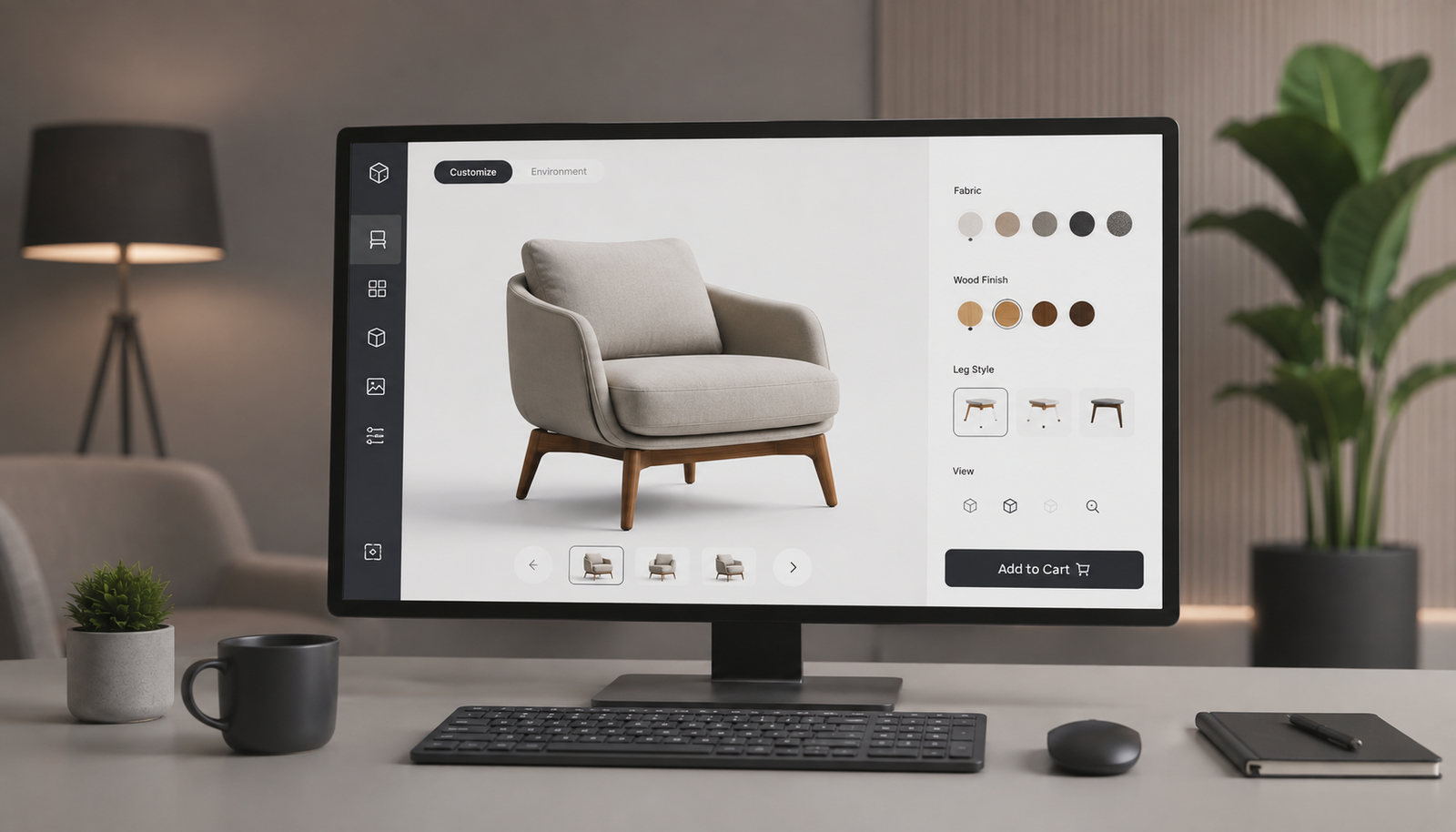
A virtual product configurator is a browser-based interactive tool that lets shoppers customize a product in real-time 3D — selecting colors, materials, sizes, and components while seeing every choice update instantly as a photorealistic render. Retail and ecommerce brands deploy virtual product configurators to increase conversion rates, reduce return rates, and lift average order value — because buyers who build their own product buy it more confidently, return it less, and spend more on upgrades they can see. Elipse Studio builds custom virtual product configurators for retail and ecommerce brands worldwide — integrating directly with Shopify, WooCommerce, Magento, and custom storefronts from day one of the project.
Building a virtual configurator for your store?
Elipse Studio scopes every configurator project from your product range, your commerce platform, and your conversion objectives.
Every ecommerce return starts the same way: a buyer looked at a product page, made a reasonable judgment, bought the product, received it — and found that the color read differently under natural light, the size was off, or the finish was not what they expected. The product was accurately described. The photography was fine. But the buyer's ability to visualize exactly what they were ordering was not enough — and the gap between imagination and reality cost the brand money, time, and customer trust.
A virtual product configurator closes this gap at the source. Instead of asking buyers to imagine what a product will look like in their preferred configuration, it shows them — in a photorealistic, real-time 3D render that updates instantly as they make every selection. The result is a buyer who arrives at checkout with zero visual uncertainty about what they ordered, and a brand that dramatically reduces the return rate, increases conversion, and lifts average order value from upgrade selections that buyers can see rather than just read about.
This guide focuses specifically on virtual product configurators for retail and ecommerce — how they work, why the ROI is documented and consistent, which product categories benefit most, and how Elipse Studio builds them for brands worldwide. For a broader look at the 3D configurator space, our complete guide to 3D product configurators covers the full landscape.
What Is a Virtual Product Configurator?
A virtual product configurator is a real-time 3D customization tool embedded directly in a product page — allowing buyers to select options, see the result rendered accurately, and proceed to checkout with a complete specification of exactly what they ordered. It runs in a standard web browser using WebGL rendering technology, requires no app download, and integrates with the brand's existing ecommerce platform and order management system.
The key word in virtual product configurator is virtual — the buyer is building a digital version of their ideal product before any physical item is committed. This is commercially significant: the decision is made at the moment of highest visual confidence, not at the moment of vague optimism about what a text description implies.
Unlike basic product page galleries that show pre-rendered images of fixed options, a true virtual product configurator renders every combination in real time. A product with 8 colors, 4 materials, and 3 size variants represents 96 possible combinations — all of which the virtual configurator renders accurately on demand without any additional photography or static asset production for each variant.
94%
Higher conversion for shoppers who use a virtual configurator vs those who don't
35%
Return rate reduction when buyers configure and visualize before purchase
40%
Average Order Value uplift through visible upgrade selection in virtual configurators
6×
Longer session time on product pages with virtual configurators vs standard pages
How a Virtual Product Configurator Works — The Technical Foundation
Understanding the technical foundation of a virtual product configurator helps retail brands evaluate what they are buying — and why quality of 3D asset production is as commercially important as the technology that delivers it.
Real-Time 3D Rendering in the Browser
The core technology behind every virtual product configurator is WebGL — a browser API that enables GPU-accelerated 3D rendering without plugins or downloads. Libraries like Three.js and Babylon.js, or full engines like Unreal Engine 5 via Pixel Streaming, power the real-time render that buyers see. Every time a buyer selects a new color, material, or configuration option, the WebGL renderer updates the 3D scene in real time — typically in under 100 milliseconds on modern devices. Our Unreal Engine configurator guide covers how UE5 takes real-time rendering to cinematic quality for premium brands.
Physically Based Rendering (PBR) Materials
The visual accuracy of a virtual product configurator depends almost entirely on the quality of PBR materials — the digital specifications of how each surface type responds to light. A leather sofa in burnt sienna, a watch case in brushed titanium, a sneaker sole in translucent rubber — each of these requires a PBR material built to accurately simulate light interaction. Elipse Studio produces every PBR material library matched to physical product specifications and sample reference, ensuring the render the buyer sees is a commercially accurate preview of the product they will receive.
Configuration Rules Engine
A virtual product configurator without a rules engine allows buyers to generate invalid configurations — combinations that cannot be manufactured, shipped, or fulfilled. A compatibility rules engine enforces valid selections invisibly: when a buyer selects an option that conflicts with a previous choice, the configurator resolves the conflict gracefully — hiding incompatible options, prompting guided decisions, or auto-selecting the compatible default. This prevents order errors downstream and eliminates the customer service overhead of managing misconfigured orders.
Ecommerce Platform Integration
A virtual product configurator that is not integrated into the commerce platform creates a friction point at exactly the wrong moment. Elipse Studio builds configurator-to-platform integration as a core deliverable — not a post-launch add-on. For Shopify and Shopify Plus, configuration data maps to variant SKUs and flows directly into the order. For WooCommerce, custom product fields carry the full specification. For Magento, Adobe Commerce, and BigCommerce, API integration connects the configurator to order management, inventory, and pricing systems. The buyer should never have to re-enter what they just built — the configured specification is the order.

See Elipse Studio's configurator work in action
Boat configurators, furniture builders, automotive selectors, apparel customizers — all built with native commerce integration.
6 Retail & Ecommerce Categories Where Virtual Configurators Deliver Strongest ROI
The virtual product configurator ROI is strongest in product categories where visual uncertainty is the primary driver of purchase hesitation and post-purchase returns. Six retail categories stand out:
1. Furniture and Home Décor
Furniture is the product category where virtual product configurators deliver the clearest measurable return — because furniture returns are expensive to process and almost always caused by the same failure: the buyer could not accurately judge the color, scale, or fit from product photography. A virtual furniture configurator lets buyers select frame finish, upholstery material, fabric color, and leg finish — seeing every combination rendered accurately in a lifestyle scene or neutral studio. Our furniture configurator guide covers the full commercial case for this category, including return rate data and AOV uplift from visible upgrade selection.
2. Fashion and Apparel
Fashion brands use virtual product configurators to let buyers select colorways, patterns, sizing, and customization options — seeing their configured garment render accurately before purchase. For brands with high SKU complexity — multiple colorways, seasonal patterns, optional embellishments — the virtual configurator generates all variant renders from one base 3D model, eliminating the need for a photoshoot for every new colorway. Our apparel configurator guide covers how fashion brands specifically are deploying this technology.
3. Footwear and Accessories
Footwear brands with customization programs — custom color blocking, material selection, lace and sole options — use virtual product configurators to make the custom product-building experience a commercial driver rather than an operational complexity. Buyers who invest time in customizing their footwear develop ownership before purchase, reducing abandonment and increasing attachment to the final configuration. Accessories brands — watches, bags, jewelry — achieve the same result with material and color selection options that would require thousands of static renders without a virtual configurator.
4. Consumer Electronics and Technology
Electronics brands with configurable product lines — laptops with finish options, audio equipment with color variants, smart home devices with material choices — use virtual product configurators to show what "Space Grey" actually looks like under realistic lighting, how the premium brushed aluminum reads against the standard plastic finish, and how the selected configuration will sit on a desk or within a home environment. The visual clarity that a virtual configurator provides for premium finish selection directly translates to higher upgrade attach rate — buyers who can see the premium finish buy the premium finish.
5. Automotive and Powersports
Automotive brands use virtual vehicle configurators to let buyers select trim level, exterior color, wheel design, interior material, and technology packages — seeing every combination rendered in accurate PBR at any camera angle, in studio or outdoor lighting. Our detailed automotive configurator guide covers the specific commercial mechanics of this category, including how the configurator shortens the dealership sales cycle and reduces post-delivery regret.
6. Sporting Goods and Outdoor Equipment
Sporting goods brands with configurable products — custom bicycles, personalized fitness equipment, outdoor gear with color and component selection — use virtual product configurators to serve the highly engaged enthusiast buyer who specifically wants to build their ideal configuration rather than choose from fixed options. The investment in a virtual configurator in this category has a multiplier effect: enthusiast buyers share their configurations, creating organic referral traffic from highly qualified prospects.
"The most expensive thing an ecommerce brand does is process a return. The second most expensive is losing a sale to visual uncertainty. A virtual product configurator solves both problems at the same time."
Elipse Studio — Virtual Configurator PracticeThe ROI Mechanics — How Virtual Configurators Create Commercial Value
The headline ROI numbers for virtual product configurators are well-documented. Understanding the specific mechanisms that generate them helps brands model the impact for their specific product category and margin structure.
Four Mechanisms That Drive Configurator ROI
+94%
Conversion
Mechanism 1 — Psychological Ownership Before Purchase
Buyers who spend 5+ minutes building their exact configuration develop psychological ownership of the product before any transaction. Behavioral economics calls this the endowment effect — and it dramatically reduces abandonment. A buyer who has built their exact sofa in the right color with the right legs is committed to that configuration in a way a buyer who browsed a static product page never is.
+40%
AOV
Mechanism 2 — Visual Upgrade Conversion
When a buyer can see the premium leather finish next to the standard fabric — not just read the names and prices — upgrade selection rates increase dramatically. The visual difference justifies the premium in a way that text descriptions and price differences cannot. This is the primary driver of the documented 40% AOV uplift: buyers upgrade because they can see what they are getting, not just what they are paying. Our guide on how 3D configurators increase ecommerce sales covers this mechanism in depth.
−35%
Returns
Mechanism 3 — Expectation Gap Elimination
A buyer who configured their product in accurate PBR 3D arrives at delivery knowing exactly what to expect. The primary driver of returns in configurable product categories — "this isn't what I thought it would look like" — is eliminated at the configuration stage rather than discovered at the delivery stage. This has compounding margin impact: every percentage point of return rate reduction in furniture, apparel, or electronics carries significant direct cost savings.
+2.4×
Referrals
Mechanism 4 — Configuration Sharing Creates Organic Traffic
A buyer who spent time building their ideal configuration wants to share it. Elipse Studio builds shareable configuration URLs into every virtual configurator — links that load the exact build the original buyer created, visible to anyone who receives it. This creates a referral channel of warm, pre-qualified traffic: the recipient clicks a link, sees exactly the configured product, and enters the funnel at maximum intent.
Extending the Virtual Configurator Into AR — See It In Your Space
The most powerful extension of a virtual product configurator is WebAR placement — letting buyers point their smartphone camera at their actual room and see the configured product placed there at accurate scale. Elipse Studio builds WebAR as a native extension of the virtual configurator experience, not as a separate tool that buyers have to find.
After a buyer completes their configuration in the virtual configurator, a "View in Your Room" button launches the WebAR session directly in their mobile browser — no app download, no context switch, no friction. The configured product appears in their space at accurate scale, in their selected finish, responding to the real ambient lighting of the room they are actually in. For furniture and home décor brands in particular, this extension closes the final remaining source of purchase hesitation: "I still can't tell if it will fit." Elipse Studio's AR development services cover the full WebAR integration scope for retail brands.
Ready to see what a virtual configurator does for your conversion?
Elipse Studio scopes every project from your product range, your commerce platform, and your specific ROI targets — and responds within one business day.
Explore Configurator Services →Frequently Asked Questions
What is a virtual product configurator?
A virtual product configurator is a browser-based 3D tool embedded in a product page that lets buyers customize a product — selecting colors, materials, sizes, and options — while seeing every choice rendered as a photorealistic 3D preview in real time. It requires no app download, integrates with the brand's existing ecommerce platform, and passes the complete configuration specification directly to checkout and order management. Elipse Studio builds custom virtual product configurators for retail and ecommerce brands worldwide with native Shopify, WooCommerce, and Magento integration.
How does a virtual product configurator increase conversion rate?
A virtual product configurator increases conversion rate through three mechanisms simultaneously: it eliminates visual uncertainty that causes abandonment (buyers know exactly what they are ordering), it creates psychological ownership through time invested in configuration (buyers who built their product are committed to it), and it captures purchase intent at peak commitment through integrated checkout. The documented conversion rate uplift is 30–94% for buyers who use the configurator compared to those who view standard product pages.
Which ecommerce platforms does Elipse Studio integrate virtual configurators with?
Elipse Studio builds virtual product configurator integration for Shopify and Shopify Plus, WooCommerce, Magento and Adobe Commerce, BigCommerce, and custom Next.js and headless ecommerce frontends. Configuration data — every selected option with its variant SKU, production code, and pricing — flows automatically into the platform's order management system without manual re-entry. See our full 3D product configurator services for platform integration detail.
How long does it take to build a virtual product configurator?
A focused virtual product configurator for a single product with standard variant options (4–8 colors, 2–3 materials, 1–2 sizes) and Shopify integration typically launches in 8–14 weeks. Multi-product configurators with complex option matrices and enterprise platform integration span 14–24 weeks. Elipse Studio provides realistic timelines at project scope, based on product complexity, variant depth, and integration requirements. Our configurator cost guide covers the factors that affect timeline and investment across different project types.
Can a virtual configurator also work as a WebAR product placement tool?
Yes — and this is one of the strongest commercial arguments for building a virtual product configurator with Elipse Studio. The same 3D model and material library that powers the configurator can be exported as USDZ and GLB for WebAR product placement — where buyers point their smartphone camera at their room and see the configured product there at scale. Elipse Studio builds this as a native extension of the configurator experience, not as a separate tool. Our AR development services cover the full scope of WebAR integration.
What is the difference between a virtual product configurator and a 3D product viewer?
A 3D product viewer shows a single fixed product model that buyers can rotate and zoom — it is a one-directional visualization tool. A virtual product configurator is interactive and bidirectional — buyers make selections and the 3D render updates in real time to reflect those choices. The configurator also connects to the commerce platform to pass the specification to checkout, whereas a viewer is typically a standalone visual tool. The commercial impact of a configurator is substantially higher because it creates purchase commitment through active customization rather than passive viewing.
The Bottom Line
The virtual product configurator is not a visual novelty or a premium feature reserved for luxury brands — it is the most commercially effective tool available for retail and ecommerce brands that sell configurable, variable, or customizable products. The documented ROI is consistent because the underlying mechanics are consistent: buyers who build their product buy it more confidently, return it less, spend more on upgrades they can see, and share what they built with people who are predisposed to buy the same thing.
Elipse Studio has been building virtual product configurators for retail and ecommerce brands worldwide since 2014 — combining 3D production depth, real-time rendering expertise, compatibility rules engine engineering, and native commerce platform integration into platforms that serve buyers as a genuine purchase decision tool. If your product range includes variants that buyers currently have to imagine, a virtual product configurator replaces that imagination with certainty — and certainty converts.
Elipse Studio · Virtual Product Configurators · Since 2014
Ready to Build Your Virtual Product Configurator?
Tell Elipse Studio about your product range, your commerce platform, and the variant complexity you need to handle. Our team responds within one business day with a scoped proposal.
Related Resources from Elipse Studio
Continue exploring the configurator ecosystem:
→ Complete Guide to 3D Product Configurators 2026
→ Furniture Configurator 2026 — How Home Brands Use 3D to Sell
→ Apparel Configurator for Fashion Brands 2026
→ Automotive Configurator — The Interactive 3D Car Buying Journey
→ Unreal Engine Configurator — Real-Time 3D Experiences That Sell
→ How 3D Configurators Increase Ecommerce Sales and Qualified Leads
→ 3D Product Configurator Cost 2026 — What Brands Actually Pay
→ Elipse Studio 3D Product Configurator Services
Latest Work
Contact Us
Let’s build something remarkable.
Share your project details and we’ll craft an experience your audience will remember.
Or reach out directly for a quicker response