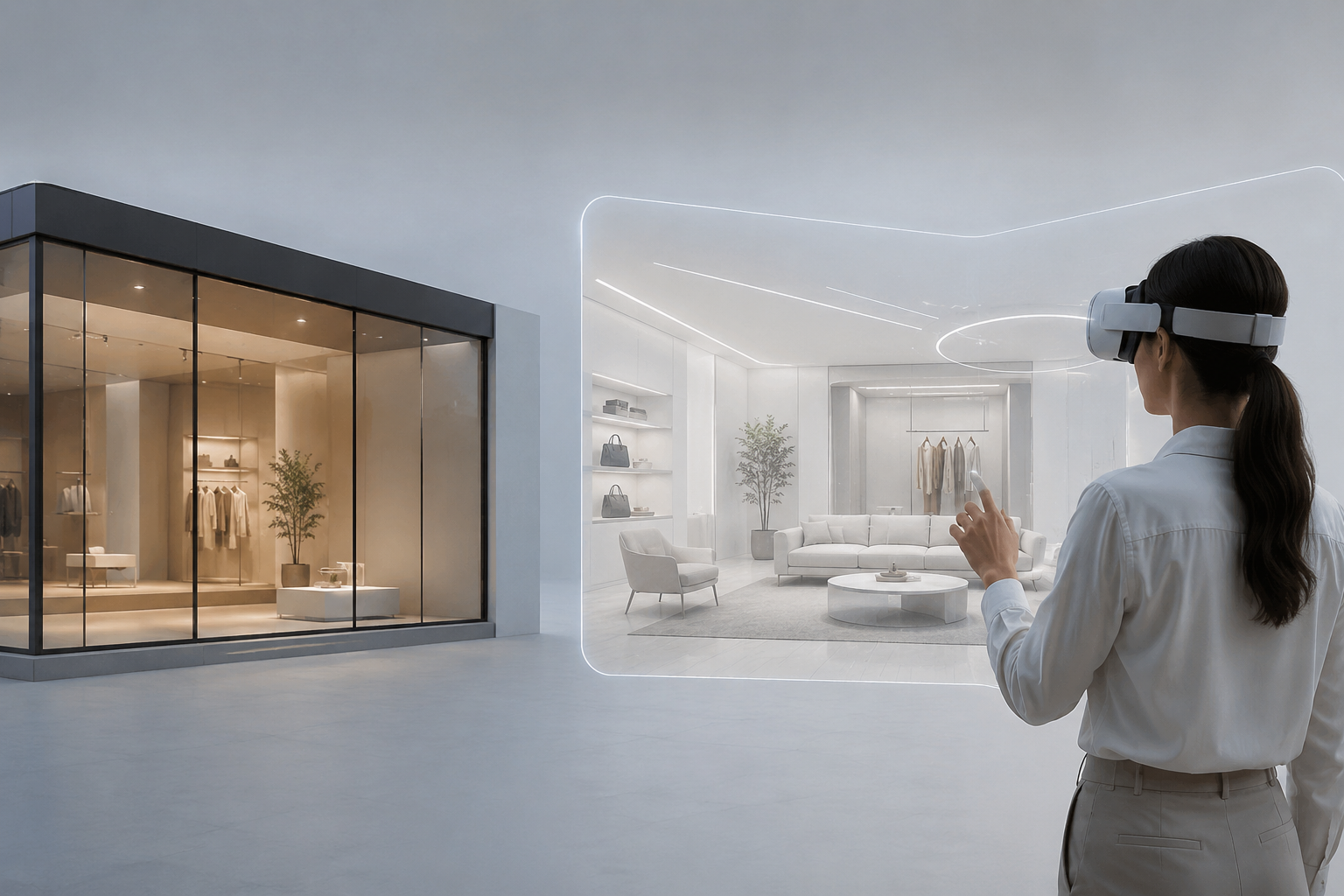
Physical showrooms exist to solve a specific problem: buyers making high-value purchase decisions need to experience a product in context — to see how it looks in a room, how it relates in scale to surrounding objects, how different finish options actually read under real light. This context-in-environment experience is what distinguishes a purchase made with full visual confidence from a purchase made on approximation and hope. Physical showrooms deliver this — but only to buyers who can visit, during hours the showroom is open, for the products currently on the floor.
In 2026, the brands that have built virtual showrooms have solved the same problem without the geographic, temporal, and spatial constraints that physical locations impose. A buyer in Tokyo can explore a furniture brand's full collection at 2am in their time zone, configure a sofa in the exact fabric they want, and place it in their room via AR before ordering — without the brand staffing a single additional person or square meter of showroom floor. This is the commercial shift that virtual showrooms represent, and it is why brands across furniture, automotive, luxury goods, fashion, real estate, and B2B manufacturing are building them as strategic infrastructure rather than marketing experiments.
Physical Showroom vs Virtual Showroom — The Commercial Gap
Constrained by Space, Time & Geography
Global Access, Always On, Unlimited Range
Types of Virtual Showrooms Elipse Studio Builds
The term virtual showroom covers a range of interactive 3D experiences that differ in scale, navigation model, and commercial function. Understanding the types helps brands identify which architecture serves their product range and buyer journey.
Walkaround Virtual Showroom — Navigate Like a Real Space
The visitor navigates through a 3D environment using point-and-click, arrow keys, or touch on mobile — moving through rooms, approaching products, and entering interaction zones. Products are presented in their natural context: a sofa in a living room scene, a car in a showroom environment, a kitchen design in an actual kitchen. This is the closest digital equivalent to walking through a physical showroom.
Product Hub Virtual Showroom — Gallery With Depth
A curated 3D environment where products are arranged for discovery rather than spatial navigation — visitors click to enter individual product experiences, each opening a full 3D configurator or visualization. The virtual showroom functions as an ambient gallery that contextualizes the range, with deep product interaction available on demand for each item.
Brand Experience Virtual Showroom — Story-Led Navigation
A narrative-structured 3D environment where the brand's story, heritage, materials, and craft are embedded in the showroom itself. Visitors move through spaces that communicate brand values — material origin stories, manufacturing process visualizations, founder narrative — alongside product display. Common for luxury, heritage, and lifestyle brands.
B2B Trade Virtual Showroom — Dealer and Buyer Portal
A password-protected virtual showroom environment serving trade buyers, dealers, and distributors with access to full product ranges including wholesale configurations, trade pricing, specification sheets, and direct ordering. The same 3D environment as the consumer showroom, with an additional data layer for authenticated trade users.
Event Virtual Showroom — Digital Trade Show or Launch
A purpose-built virtual showroom for a specific product launch, trade show, or seasonal collection reveal. The environment is designed around a moment rather than an always-on destination — with live streaming capability, scheduled brand presentation sessions, and real-time visitor interaction. Built for a defined period, then evolved into a permanent showroom or archived.
Exploring a digital showroom for your brand?
Elipse Studio scopes every project from your product range, buyer journey, and commercial objectives.
Industries Where Virtual Showrooms Are Delivering Strongest ROI
Furniture & Home Décor
Full room context, material configuration, AR room placement — the category where showroom investment delivers most directly to conversion and return rate reduction.
Automotive
Virtual dealership experiences showing full model ranges with exterior color, interior, and trim configuration — accessible to buyers globally before a physical visit.
Luxury & Fashion
Seasonal collection environments with brand story integration — delivering the premium context that luxury buyers expect, accessible without a flagship store visit.
Real Estate
Off-plan property virtual showrooms where buyers explore unit layouts, finishes, and amenities before construction — driving pre-sales to global buyer audiences.
B2B Manufacturing
Trade virtual showrooms replacing costly physical exhibitions — full product ranges presented to international buyers without logistics overhead.
Beauty & Cosmetics
Product launch environments with texture visualization, shade exploration, and AR try-on — creating brand immersion that standard product pages cannot deliver.
Marine & Powersports
Virtual boat showrooms, motorcycle galleries — high-value products that buyers research extensively before physical evaluation, perfectly suited to 3D showroom depth.
Medical & Healthcare
Medical device virtual showrooms for hospital procurement — demonstrating complex equipment in accurate clinical environments without the logistics of physical demonstrations.
What Elipse Studio Builds Into Every Virtual Showroom
A virtual showroom is not a single technology — it is an integrated platform that combines 3D environment design, product visualization, interaction systems, commerce connectivity, and analytics. Understanding what each layer delivers clarifies why the build investment is justified by the commercial outcomes.
Photoreal 3D Environment
Cinematic interior spaces built with accurate lighting — Lumen GI for UE5 deployments, high-quality PBR rendering for WebGL. The environment is the brand's context: every material, surface, and light source communicates visual positioning.
Embedded Product Configurator
Products inside the virtual showroom are not static — visitors configure color, fabric, finish, and dimensions directly within the showroom environment, seeing changes reflected in the room context around the product.
AR Room Placement
From inside the virtual showroom, visitors can tap to place any configured product in their actual physical room via WebAR — completing the journey from showroom discovery to confirmed spatial fit without leaving the session.
Live Sales Integration
Sales team presence inside the virtual showroom via live chat, video call trigger, or guided tour mode — the showroom hosts human sales conversations the same way a physical space does, without the geographic constraint.
Commerce Checkout Integration
Products discovered and configured in the virtual showroom add directly to cart and proceed to Shopify, WooCommerce, or Magento checkout — the entire journey from discovery to purchase in a single browser session.
Engagement Analytics
Every navigation path, product interaction, configuration selection, and session duration tracked — giving sales teams buyer intent data that physical showrooms cannot produce and enabling data-driven follow-up for high-engagement visitors.
"A physical showroom shows your product to the buyers who find you. A virtual showroom shows your product to every buyer who could ever find you — at any hour, from anywhere in the world."
Elipse Studio — Virtual Showroom PracticeThree Access Modes — One Virtual Showroom
Elipse Studio builds every virtual showroom with progressive delivery across three access modes — so the same environment serves buyers on desktop browsers, mobile phones, and VR headsets without requiring separate development for each platform.
Desktop Browser
Full 3D walkaround navigation via mouse and keyboard. Highest visual quality — optimized for buyers doing thorough product research on desktop or laptop.
WebGL / WebXRMobile Browser
Touch-optimized navigation — tap to move, swipe to look, pinch to zoom. Adapted rendering for mobile GPU performance without degrading the brand experience.
iOS Safari / AndroidVR Headset
Full first-person immersive walkthrough on Meta Quest 3 or PICO 4. The highest-engagement access mode — used for key buyer presentations, trade shows, and flagship experiences.
Meta Quest · PICOCommerce and CRM Integration — The Virtual Showroom Connected to Revenue
A virtual showroom that creates immersive product exploration but cannot connect that exploration to a purchase or a qualified lead record loses the commercial value of every buyer session. Elipse Studio builds every virtual showroom with native integration into the client's commerce and sales infrastructure — not as a post-launch addition, but as a core requirement of the first sprint.
When a buyer explores a product in the virtual showroom and adds it to their saved configuration, that interaction creates a record — in HubSpot, in Salesforce, or in a custom CRM — with the exact products viewed, options configured, and session depth data attached. Sales teams receive not just a contact record but a buyer profile: what they looked at, what they configured, how long they spent, and what questions they triggered with the live chat system. This intelligence makes every sales follow-up from a showroom session more targeted and more likely to convert than a cold lead from a contact form.
Virtual Showroom ROI — Metric by Metric
| Metric | Physical Showroom | Static Website | Virtual Showroom |
|---|---|---|---|
| Geographic reach | Local only | Global, flat | Global, immersive |
| Access hours | Limited | 24/7 | 24/7 immersive |
| Product range shown | Floor space limited | Full catalog | Full catalog in context |
| Avg. session time | Long (physical) | Short | 3× longer than web |
| Engagement data | None | Basic pageviews | Full interaction map |
| Launch / update cost | Very high (physical) | Low | Moderate — then low |
| Product context | Full room context | Flat imagery | Full room context |
| AR placement | Not available | Separate tool | Embedded in experience |
| Live sales capability | In person | Separate chat tool | Embedded live chat/video |
See Elipse Studio's virtual showroom portfolio
Interactive product environments built for brands worldwide — across furniture, automotive, luxury, and B2B.
The Permanent Advantage of a Virtual Showroom
The strategic case for a virtual showroom in 2026 goes beyond the individual commercial metrics — conversion rate, session time, geographic reach — to a structural point about how brands compete for buyer attention and trust. Physical showrooms are expensive, geographically bounded, and operationally rigid. A virtual showroom built with the quality and integration depth that Elipse Studio delivers is none of these things.
The brands that build online showrooms as strategic infrastructure — not as campaign activations or marketing experiments — are the ones that compound the advantage over time. The 3D environment improves with each product line added. The analytics accumulate into a detailed picture of buyer behavior that continuously improves sales follow-up. The geographic reach expands the addressable market without additional distribution cost. And the buyer experience quality gap between brands with virtual showrooms and brands without them widens as buyer expectations, shaped by the best experiences in the market, continue to rise.
Elipse Studio builds virtual showrooms for brands worldwide — from the 3D environment design and product visualization through to commerce platform integration, VR headset delivery, and analytics instrumentation. If your brand currently relies on a physical showroom to create the context-in-environment experience that drives purchase confidence, or if your ecommerce presence is losing buyers to the imagination gap that flat product pages create, the conversation about what a virtual showroom could deliver starts with your product range and your buyer journey.
Frequently Asked Questions
What is a virtual showroom?
How is a virtual showroom different from a standard product page?
Can a virtual showroom integrate with Shopify checkout?
Does a virtual showroom work on mobile and VR headsets?
What analytics does a virtual showroom provide?
How long does it take to build a virtual showroom?
What makes Elipse Studio's virtual showrooms different?
Related Topics
Elipse Studio · Virtual Showroom
Ready to Build a Virtual Showroom That Sells Around the Clock?
Tell Elipse Studio about your product range, your buyer journey, and the commercial problem you need to solve. Our team responds within one business day with a scoped approach for your showroom project.